Monday, March 2, 2015

Aboriginal Rock Painting March 2

In a pouring rain this morning we went to the part of Kakadu National Park where many rock paintings are located.  We first took a vigorous walk up to a very large sheltered area under the overhang of a mammoth rock:


 This is a place where the Aboriginal people who lived here sheltered during the rainy season, and indeed it was quite dry.  There is a very old painting of a kangaroo here:


The rock paintings often have many layers of artwork, as the creative process was more important than the finished product, and many of the sites have many layers of art, making the dating of them very difficult.  They range in age from hundreds of years to tens of thousands of years with not much change in the art or the materials.  Some of the paintings have been explained to westerners, but some have not as they have secret and sacred meanings.  The ones we saw were all on sheltered rock faces but none were in caves.  The materials were different colors of ochre, mostly red, yellow and white.  We walked along the side of the escarpment from one rock face to another on a very nicely done system of paths and boardwalks designed to give a good view of the art but to protect the entire area.  Here are some samples.  First a spirit-person:

A very old painting of a spear thrower using a hide launcher with a far more recent painting of a kangaroo:


 This next painting was identified on the sign accompanying it as relating to dancing.  Our guide, who is white but has fluency in three of the Aboriginal languages and has been adopted by one, told us that was hogwash.  The woman anthropologist who first saw this said to the Aboriginal people accompanying her that it looked like dancing to her.  They very much wanted to please her, or they didn’t want to share the real meaning, so they agreed it was dancing.  Our guide said it has to do with sorcery, something like voodoo, but in respecting the confidentiality of the people he wouldn’t say more.  He said he’s been trying to get the government to take down the dancing sign for years, but the woman anthropologist is prominent and he cannot get it done.  So this is either dancing, or more likely, sorcery:


Here’s a very old (tens of thousands of years) picture which includes a woman giving birth:


 This one is really interesting!  It’s Nabulwinjbulwinj, “a dangerous spirit who eats females after striking them with a yam”.   Posted without comment!


Finally, Lightning Man, or Namarrgon, part of the Dreaming and the creation myth.  These are very complicated stories:


 Just as we finished visiting the rock art the rain stopped!  Steamy and humid air settled down, and we walked back to our bus.  We stopped for lunch and then drove the three+ hours back to Darwin.

Kakadu National Park March 1

The weather is far better than when we arrived yesterday.  Highs in the high 80’s, still 100% humidity, and no rain all day!  With a broad-brimmed hat, lots of water and lots of sunscreen it works.

We began the day with a 90-minute lecture on the park and the people who have lived here.  The naturalist who spoke was wonderful, and his information supplemented the extensive handout we had been given.  We then went to the park’s visitor center, where a board of road closings attested to the ferocity of the monsoon rains:


Here is an explanation of the six seasons recognized by the Aboriginal people:


 The Visitor Center’s displays were quite extensive and helpful.  After lunch we went for a “Yellow Water Cruise”, a boat ride for two hours on the flood waters and on the East Alligator River (named by an explorer who confused alligators with crocodiles).  It was hard to tell when we moved from the river to the floodplain—all was water:


Here is a whole vista of water lilies:


And here is a single lotus lily:


 There’s an extensive collection of fauna here; these are magpie geese:


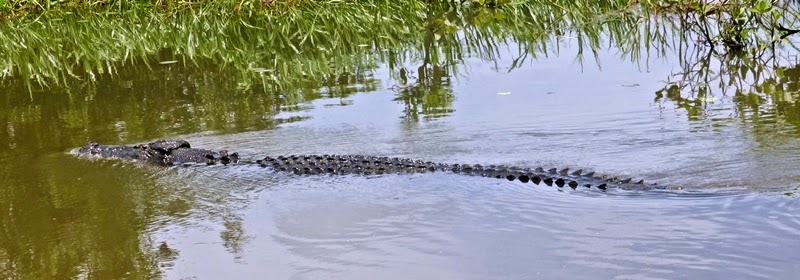
 And the very scary saltwater crocodile.  Just last week a12-year old girl was eaten by one, we were told:


 Here’s the jacana which has very specialized splayed-out toes to be able to walk on lily pads:


And here’s the sea eagle:


 On the way back to the launch we came across a rare sight.  The male jacana cares for the newly hatched chicks and protects them under his wing.  In this photo you can see the wing bulged out by a chick underneath, and in the lower left corner of the photo you can see a chick just exploring away from its dad:


 By now we were sweltering and partially baked, but at least we had not been rained on.  Our final stop of the day was at the Warradjan Cultural Center where no photos were allowed.  This center is devoted to explaining the lives, beliefs and practices of the Aboriginal people who lived in this part of the country and it was extremely well-done and full of great displays and information.  

Back to the hotel for dinner and rest; tomorrow Aboriginal rock painting.

Sunday, March 1, 2015

Adelaide to Kakadu February 28

Up early this morning for a travel day, as we need to get to the airport for our three-hour+ flight north northwest to Darwin in the Northern Territory.  Another time change—although Darwin is in the same time zone as Adelaide, it does not keep daylight savings time, so we set our clocks back an hour.  We’re still ½ hour off of the rest of the world.

As the plane landed and the doors opened, there was a blast of extremely hot, extremely humid air.  It was almost hard to breathe!  We got our bags and got onto our bus for the ride east to Kakadu Park, which took about three hours.  We had a box lunch on the bus.

In this part of Australia the Europeans identify two seasons—hot wet and rainy, and hot but bone dry. We are at the height of the rainy season.  On the bus we had a wonderful introduction to the Aboriginal peoples who make up about 30% of the scant population here.  We also were given a very well-done 34 page handout on Kakadu National Park and on the Aboriginal peoples who have lived here for at least 20,000 years and perhaps a many as 50,000 years. When we arrived at our hotel in the park the temperature was 97 degrees and the humidity 100%.  One of us has a converter which said that the effective temperature was 108.  It was HOT.

The land here is extremely flat, an alluvial plain with a rock escarpment about 20 miles inland from the ocean.  In the wet season, the monsoon rains flood the plain, and the whole area becomes a wetland:


It all dries up in the dry season!  The Aboriginal people have six seasons which they identify, and have no calendar.  The dates of the seasons vary year to year depending on how early or late the natural changes occur.  Seasons don’t start or stop on a given date, but rather are said to begin and end when the things which occur during that season actually happen.  This is just one of the very practical and pragmatic things we learned which are practiced by the native people.  There’s lots to read and learn and it will be very interesting. 


There was a huge tropical absolutely monumental rain which lasted for about an hour while we had dinner, and then it stopped and the temperature had cooled.  It must be a frigid 80, with still 100% humidity, as we prepare to go to bed.  Our air conditioning works!

Australian Wines February 27

Adelaide  February 27

We started the day at a very reasonable 9:00 which felt wonderful.  We are well-rested.  We drove to the Barossa Valley which is about an hour and a half northwest of Adelaide and is the source of many of Australia’s best wines as well as its less expensive but very drinkable wines (such as Yellowtail and Jacob’s Creek).  Our first visit was to the Yalumba Winery:


This beautiful winery has the only cooperage in Australia, and we had a tour of it:


They use oak from the USA and from France, and put out barrels of various sizes: Puncheon, Hogshead, Barrique, Quarter Cask, and Octave:


We had a tasting of five different wines and an extensive description of the winemaking.  We especially liked a white called Yolumba Viognier, which we will look for when we get home.  We had a tour of the winery and then a phenomenal lunch which was completely created from local meats, cheeses and breads.  Of course there was wine at lunch, and we sort of fell into a post-prandial torpor.  We roused ourselves to visit a smaller boutique winery named for the man who runs it and who spoke to us, Charles Melton.  He is, we were told, an internationally famous wine-maker and he was really fun and interesting to listen to.  He took us out into the vineyard which is bursting with grapes as it is now harvest time:


We then, of course, had a tasting of five of his wines, all of which are expensive to very expensive, and got on the bus for the ride back to Adelaide.

Up early tomorrow for a travel day—in the morning we fly four hours north to Darwin and then drive another three or four hours to Kakadu National Park, with lectures on the bus about Kakadu and the Aboriginal peoples.

Friday, February 27, 2015

Kangaroo Island, Day 2 February 26

Day two of our visit to Kangaroo Island began with the Kelly Hill Caves, an extensive cave system with lovely caverns, and many stalagmites and stalactites.  We had a ranger-led tour deep into the complex:


At Hanson Bay I couldn’t resist another wild Koala photo:


We then went to a formation called “Remarkable Rocks” and learned of the geologic activity which led to its creation, following which we hiked down to and on to the rocks.  They are pretty amazing:


After lunch we went to a long and difficult predominately vertical walk (on a boardwalk and stairs) to a truly beautiful natural arch, out of which you could see a large colony of Australian Fur Seals cavorting in the waves and on the rocks.  They truly seemed to be having fun:


We then went to a lovely reserve where there is a path called “Koala Walk”.  Many eucalyptus have been planted in broad avenues to attract koalas, and it’s been successful:


 Finally we went to the local Kangaroo Island airport for the short flight on a regional scheduled airline back to the Adelaide airport.  No security.  None.  We got our boarding passes without showing any ID, just gave our names, and simply got on the 33-passenger jet-prop when the flight was called.  We arrived at the hotel in time for 8:00 PM dinner, and right to bed after.

A comment on the Australian marsupials, which are fascinating.  Most of their joeys (all marsupial newborns are called joeys) are born incredibly tiny, weighing on the order of 2 or 3 grams (one tenth of an ounce).  They must make their way from the birth canal to the pouch on their own, and find their teat in the pouch.  They then glom on to a teat and don’t let go for months until their development is far advanced and they can stick their heads out of the pouch.  The female kangaroo is fertile just a couple of weeks after giving birth, while she is lactating, and can have joeys of different ages in her pouch at the same time.  Even more remarkably, the milk she gives can be different from different teats depending on the age of the joey nursing, as the milk content required is different at different ages.  The echidnas (we saw a spiny anteater) are monotremes and have a cloaca from which all things exiting the body come.  These remarkable egg-laying mammals curl up into a ball to deliver the fertilized egg into the pouch where it is held until delivery of the baby which then nurses on the fur over the mammary glands, as they have no nipples.  This has been an amazing biology lesson!


Tomorrow Australian wines.

Kangaroo Island I February 25

Up at 6:00 to pack, check our large bags, and get to the ferry terminal at Cape Jervis for the ferry to Kangaroo Island.  The island is very large and has an abundance of things to see and do.  We’ll stay overnight tonight, have another full day on the island tomorrow and fly 20 minutes back to Adelaide tomorrow night on a small plane with a baggage limitation of 15 pounds.

The island is very beautiful, with a substantial portion of it dedicated to parkland and public beaches:


 We began touring at a eucalyptus oil plant where we had a fascinating tour of the production facility (which was quite basic):


This facility sells pure eucalyptus oil which actually has been distilled from the mixture of oil and water obtained from boiling the leaves in giant vats.  The oil is promoted to have many uses; the scientist in me is skeptical of most of the claims.

We next visited Seal Bay where, after lunch, we had a ranger-led visit to the sea lions on the beach.  Why this is Seal Bay is confusing, as Kangaroo Island has seals in another location which we will see tomorrow, but here at Seal Bay are sea lions.  The major difference is that sea lions have real rear legs and can walk on them, while seals have rear flippers and cannot raise their bodies off of the sand or rocks:


We then went to a sheep dairy and learned a considerable amount about the dairy farming of sheep.  We got to tour the milking barn and taste a number of varieties of sheep milk cheese:


Not done yet, we went to a honey farm! The beekeeper here has an enormous number of bees and produces honey from a number of different sources.  We got to taste five different honeys and indeed, they are quite different from one another:


Finally, after the honey farm, we went to a wharf where every day, precisely at 5:00 PM, a man feeds the pelicans.  This is a truly wonderful sight, as he has some patter which he presents as he first teases and then feeds the patiently waiting birds:


 Exhausted, we checked into our hotel, had dinner, and crashed!  More tomorrow.

Wednesday, February 25, 2015

Adelaide, Potoroos and a Joey February 24

Tuesday, February 24  Adelaide

Up very early and we departed the Indian-Pacific train at 7:00.  We went immediately to the enormous Adelaide Market which was just opening up:


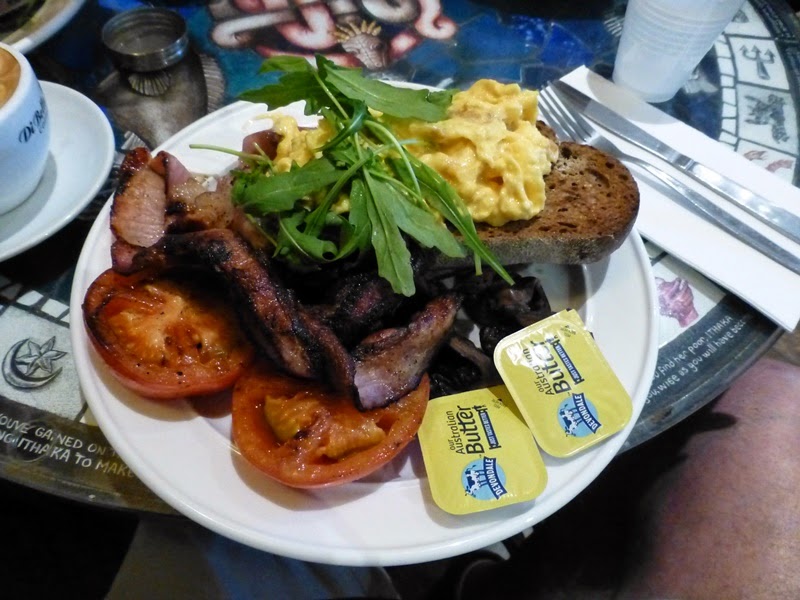
We were pointed to a couple of different places which would be good for breakfast, both of which were very busy.  I ordered a “complete breakfast” and here’s what came:


Two scrambled eggs on two very thick slices of rye toast, a giant pile of bacon, two large sausages underneath the bacon, and a whole tomato which had been split and cooked.  It was breakfast for four.  I ate breakfast for one.

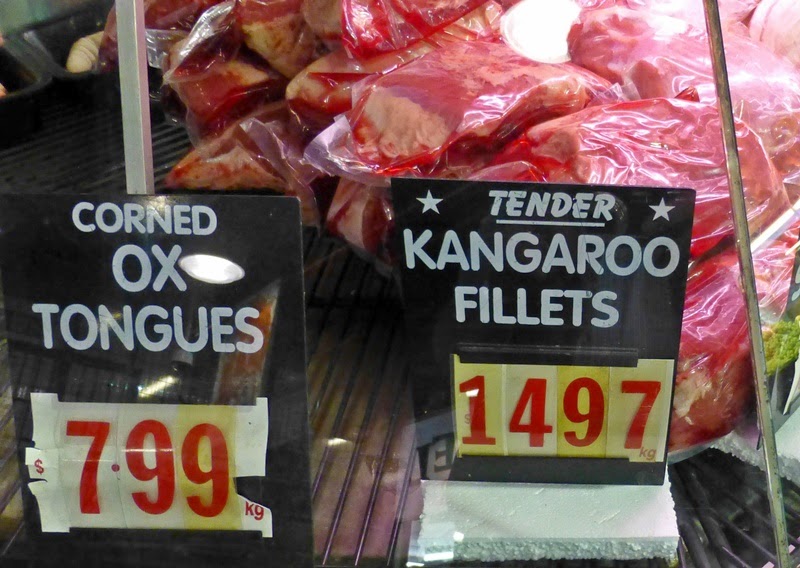
By now the market was open and busy, and we toured it.  The fruit and vegetable stands were lovely, but it was the meat markets which really caught our attention:


 And finally, Western New York


We then toured this lovely city of 2+ million people.  On the walking portion we passed the Migration Museum, and stopped to view a number of poignant plaques which were mounted on the museum walls while we heard some of the horrific stories they represented.  Here’s one:


 We then drove around the city; the entire city is surrounded by very large contiguous parks, a ring of green which is enormous and well-used.  It couldn’t be lovelier.  We then went to the extensive Botanic Gardens, had lunch there, and then had a docent-led tour emphasizing the use the Aboriginal people made of plant materials.  It was absolutely fascinating.  The core plant material they used came from the eucalyptus tree, and they used every part of it extensively:


We saw something I don’t think we have at home, a Tree-roosting Duck:


Finally we went to our hotel, checked in, and had a lecture on the city of Adelaide, its history and population, and an introduction to Kangaroo Island where we go on Wednesday.  At 6:00, still up and going, we went to the Cleland Wildlife Park, a game reserve located in a much larger national park about a half-hour out of town and up on a hillside.  We had a barbeque dinner there while the sun set, and then, at dusk, had a game walk to see nocturnal animals.  As it was quite dark, these photos are not as good as those I’ve taken in the day, but we had a wonderful walk.  The Potoroo is a small marsupial (sort of looks like a large rat).  Here’s one with a joey (baby) in the pouch.  The joey was the size of a fingernail when born:


 There are both resident and visiting kangaroos:


Tasmanian Devils:


And, of course, there are koalas.  There are resident ones and visitors who come and go.  Here’s an awake (!) visiting koala in a eucalyptus tree:


 Tomorrow off to Kangaroo Island.  Wake up will be at 5:00 AM.  We’re exhausted!